Choosing the Correct Acrylic Diffuser
How to Choose the Correct Diffuser: A Technical Guide
The CLAREX DR-IIICX Bulk Diffuser series is available in transmission levels ranging from 45% to 93%, in 5% increments. With so many options, how do you know which one is best for your application? The answer depends on the balance you need between brightness and uniformity.
How CLAREX Diffusers Work:
Textures and particles are used to diffuse light.
The front and back surfaces of all of the standard diffuser sheets have a heavy matte texture. These textures are specifically designed for diffusion. And then light scattering particles are loaded into the acrylic sheets to increase the amount of diffusion.
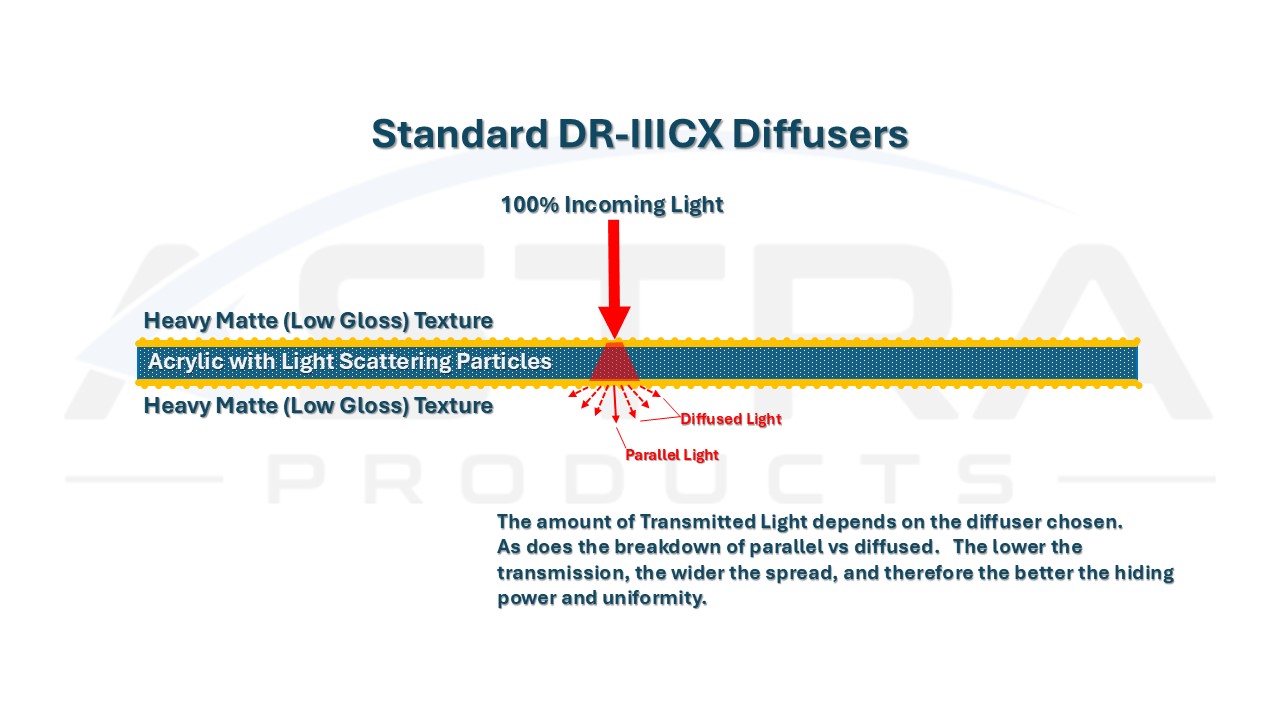
The transmission varies depending on the density of light scattering particles.
All of the DR-IIICX diffusers have a heavy matte (low gloss) texture on the front and back surface which create a base level of diffusion. Then, light-scattering particles are loaded into the sheets. The higher the density of particles loaded in, the higher the light diffusion and the lower the total light transmission. See the image below:

Transmission vs. Diffusion: Finding the Right Balance
As shown in the image above, the lower the DR-IIICX transmission, the more diffusion you’re going to get. That also equates to more hiding power. You want to find the transmission level that gets you the best balance between brightness and uniformity. For instance if you choose a high transmission diffuser, you may see hot spots from your LED backlights. On the other hand, if you choose the lowest transmission diffuser, you may get a nice and uniform backlight, but you could be blocking more light than you need to. See the example below:

Luckily, the CLAREX DR-IIICX diffusers are available in 5% increments from 45% up to 93% transmission, so you can find a diffuser in that sweet spot where you get the uniformity you need with minimal loss of transmission. Oftentimes, the best way to do that is by trial and error. We can help you there. Please contact us, and we could get you some samples to test out.
The Role of the Light Source Gap:
The effect of the gap between the diffuser and the light source.
Another critical consideration when designing a backlight is the gap between the light source and the diffuser.
- Larger Gap – Hot spots are easier to eliminate, allowing you to use a higher transmission diffuser for maximum brightness.
- Smaller Gap – Hot spots are more visible, making a lower transmission diffuser necessary to maintain uniformity.
Example Below: With DR-85CX (85% transmission), a larger gap helps maintain both brightness and smooth backlighting.

If you have the space in your design and can leave a bigger gap between the diffuser and light source, you will be able to use a higher transmission diffuser without having to worry about hot spots and poor uniformity. On the other hand, if there is only a small gap, you will likely need to use a lower transmission diffuser to hide the hot spots and maintain acceptable uniformity.
Diffuser Sheet Customization Options:
As with all CLAREX products, you have the option to customize the DR-IIICX sheets to better suit your application. For instance,
- Glossy Surface on one or both sides – For optical bonding applications.
- Hard coat Finish – For improved scratch and chemical resistance if your diffuser will be subject to handling or chemical exposure.
- Color Options – Beyond pure white, diffusers can be tinted for specialized design needs.
- Thicknesses – Can be selected to balance structural needs with optical performance.
Alternative Diffuser Options:
A note about the DR-IIISX Series of lower transmission diffusers.
We offer another line of bulk diffusers called CLAREX DR-IIISX. This line of diffusers was added to the diffuser lineup for applications where the light source is very bright and needs to be reduced. This line of diffusers is available from 5% up to 40% transmission in 5% increments, so we have many options available to allow you to choose the best fit for your application.
Please note that unlike the DR-IIICX diffusers, all of the DR-IIISX diffusers have the same diffusion/spread; only the percentage of transmission varies.
Conclusion: How to Choose the Correct Acrylic Diffuser
Choosing the correct diffuser means balancing brightness, diffusion, and uniformity to meet your application’s performance targets. Factors like transmission percentage, scattering particle density, and light source distance all play a role.
At Astra Products, we offer the DR-IIICX series in 45%–93% transmission levels, along with alternative diffuser families and custom options. Our team can provide guidance, samples, and data to help you find the best fit for your project.